
How Many Calories in a Greggs Belgian Bun?
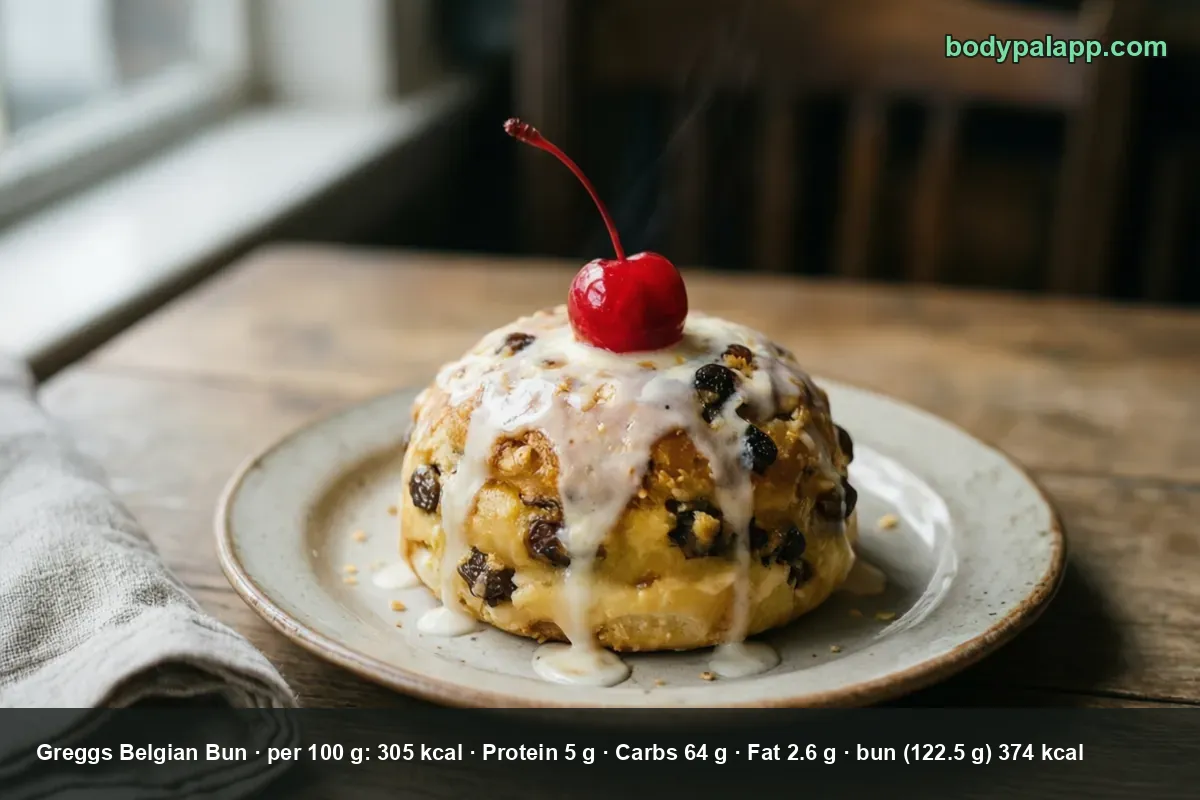
A Greggs Belgian Bun is 374 calories. The bun weighs 122.5 g and works out at 305 calories per 100 g, which is the lightest thing per gram on the sweet counter. It is also the one carrying 46 g of sugar, and that second number is the one worth stopping on.
On this page
- Greggs Belgian Bun quick facts
- Half a bun and other real portions
- The 46 g of sugar in one bun
- The same sugar counted two ways
- The sweet bun beats the sausage roll
- What is actually in a Belgian bun
- Greggs against the rest of the counter
- Supermarket Belgian buns are smaller
- Belgian bun against the other sweet bakes
- Why there is no fibre line
- Most popular Greggs products
- FAQ
Greggs Belgian Bun quick facts
Figures are Greggs' own, for the 122.5 g bun sold over the counter.
| Nutrient | Per 100 g | Per bun (122.5 g) | RI%* |
|---|---|---|---|
| Energy | 305 kcal / 1,281 kJ | 374 kcal / 1,571 kJ | 18.7% |
| Protein | 5 g | 6.1 g | 12.2% |
| Carbohydrates | 64 g | 79 g | 30.4% |
| – of which sugars | 37 g | 46 g | 51.1% |
| Fat | 2.6 g | 3.2 g | 4.6% |
| – of which saturates | 0.9 g | 1.1 g | 5.5% |
| Salt | 0.41 g | 0.5 g | 8.3% |
*RI% = one bun's share of an adult's daily reference intake, based on 2,000 kcal.
Two rows fight each other. Fat is 3.2 g, under 5% of the day, which for a bakery item is close to nothing. Sugar is 46 g, over half the day's reference intake in a single item. This is a high-sugar, low-fat product, which is the reverse of almost everything else Greggs sells.
Verified nutrition data
Numbers on this page come from CoFID, the UK government’s Composition of Foods Integrated Dataset, and from manufacturer labels where a branded product is named. Last verified August 2026. How we verify our data →
Energy in kilojoules is printed as 1,571 kJ per bun rather than the 1,565 kJ you get by multiplying the calories. Manufacturers calculate kilojoules straight from the macros using the official energy factors instead of converting from kcal, and the two routes land 6 kJ apart. It is a rounding artefact, not a discrepancy.
Half a bun and other real portions
Nobody weighs a bun, but plenty of people share one or leave half in the bag for later.
| Portion | Weight | Calories | Carbs | Sugars | Salt |
|---|---|---|---|---|---|
| Quarter of a bun | 30.6 g | 93 kcal | 19.6 g | 11.3 g | 0.13 g |
| Half a bun | 61.25 g | 187 kcal | 39.2 g | 22.7 g | 0.25 g |
| One bun | 122.5 g | 374 kcal | 79 g | 46 g | 0.5 g |
| Two buns | 245 g | 748 kcal | 158 g | 92 g | 1.0 g |
| Per 100 g | 100 g | 305 kcal | 64 g | 37 g | 0.41 g |
Half a bun is the portion that changes the picture most. At 187 kcal it costs less than a Glazed Ring Doughnut, and it brings the sugar down to 22.7 g, which lands under the daily limit instead of over it. The cherry and the thickest patch of fondant tend to go with the first half, so the halves are not identical, but the label figure is an average across the whole bun and half of it is the honest way to log it.
Two buns is where the arithmetic turns unpleasant: 748 kcal and 92 g of sugar, which is more sugar than a whole day's reference intake and then some.
The 46 g of sugar in one bun
The NHS puts the ceiling for free sugars at 30 g a day for adults. One Belgian Bun contains 46 g of total sugars. The government's own dietary recommendations set the free sugars limit slightly differently by sex: under 33 g a day for men aged 19 to 64 and under 27 g for women. Against those, 46 g is 139% and 170%.
Here is the honest complication, and most pages that quote this number skip it. Sugars in dried fruit do not count as free sugars under the SACN definition, and this bun is built on soaked sultanas. So not all 46 g are free sugars. Greggs does not publish how many grams of sultanas go into each bun, so the only defensible move is to test the range rather than invent a figure. Sultanas carry 69.4 g of sugar per 100 g in UK government composition data.
| If the bun contains | Sugar from sultanas | Free sugars, at least | % of 33 g (men) | % of 27 g (women) |
|---|---|---|---|---|
| 10 g sultanas | 6.9 g | 39.1 g | 118% | 145% |
| 15 g sultanas | 10.4 g | 35.6 g | 108% | 132% |
| 20 g sultanas | 13.9 g | 32.1 g | 97% | 119% |
| 25 g sultanas (generous) | 17.3 g | 28.7 g | 87% | 106% |
Even at 25 g of sultanas, which is a lot of fruit for one bun, the free sugars still come to 28.7 g. That is 87% of a man's daily allowance and 106% of a woman's, from one item. At the more realistic end of the range it is well past both.
For scale in a unit people can picture: 46 g of sugar is 3.6 level tablespoons of granulated sugar, tipped into one bun.
The same sugar counted two ways
The bun's label says 51% of your reference intake for sugars. The paragraph above says 139%. Both are correct, and the gap between them is the single most useful thing on this page.
The 51% figure divides 46 g by 90 g, the reference intake for total sugars used on packaging. That 90 g includes the naturally occurring sugars in milk and whole fruit, which nobody is being told to cut. The 139% figure divides 46 g by 33 g, the limit for free sugars, meaning sugar added by the manufacturer plus what is in syrups, honey and juice. Different denominators, same numerator.
Traffic-light labels and RI percentages are built around the first definition, so a product can show a mid-range amber for sugars while eating most of a day's free sugars budget. When a page or a pack quotes a sugar percentage, the question worth asking is which of the two it is dividing by. If you are tracking intake as part of managing your weight, the free sugars figure is the one that matters.
The sweet bun beats the sausage roll
A Belgian Bun is 374 kcal. A Greggs sausage roll is 347 kcal. The iced bun wins by 27 calories, which catches people out, because the mental model is that pastry and meat are the heavy option and cake is the light one.
| Nutrient | Belgian Bun | Sausage roll |
|---|---|---|
| Weight | 122.5 g | 103 g |
| Calories per item | 374 kcal | 347 kcal |
| Calories per 100 g | 305 kcal | 337 kcal |
| Fat | 3.2 g | 24 g |
| Saturates | 1.1 g | 11 g |
| Sugars | 46 g | 0 g |
| Protein | 6.1 g | 9.1 g |
| Salt | 0.5 g | 1.5 g |
Per 100 g the sausage roll is denser, at 337 against 305. The bun wins on the total because it is a bigger object: 122.5 g against 103 g. Size, not richness.
The profiles are mirror images. The sausage roll carries 24 g of fat and no sugar at all; the bun carries 3.2 g of fat and 46 g of sugar. Salt runs the other way, 1.5 g in the roll against 0.5 g in the bun, three times as much. Neither is the "healthy" one. They are expensive in opposite currencies, and which one costs you more depends entirely on what you are watching.
If the target is calories alone, they are close enough that it barely matters. If it is saturated fat, the bun wins by a distance. If it is sugar, it is not a contest.
What is actually in a Belgian bun
Greggs describes it as a soft fruit bun with lemon-flavoured pieces, soaked sultanas and apricot jam, topped with fondant icing and a glace cherry. That description explains the whole nutrition panel.
Three of those components are almost pure sugar. Fondant icing runs at 88.9 g of sugar per 100 g, apricot and other stone-fruit jam at 69.3 g, and sultanas at 69.4 g. The cherry on top is a glace cherry at 294 kcal per 100 g. The dough underneath is an ordinary enriched bread dough, which is why fat stays at 2.6 g per 100 g while carbohydrate climbs to 64 g.
That is the shape of the product: bread plus three sugar deliveries stacked on it. There is no butter lamination, no cream, no chocolate. Everything expensive about it, calorie-wise, arrived as sugar.
Allergens, from the same official listing: soya, sulphites and wheat.
Greggs against the rest of the counter
| Greggs item | Weight | Calories per item | Sugars | Salt |
|---|---|---|---|---|
| Belgian Bun | 122.5 g | 374 kcal | 46 g | 0.5 g |
| Sausage roll | 103 g | 347 kcal | 0 g | 1.5 g |
| Steak Bake | 136.4 g | 411 kcal | 0 g | 1.4 g |
| Chicken Bake | 150.4 g | 426 kcal | 1.2 g | 1.8 g |
| Cheese & Onion Bake | 141.4 g | 436 kcal | 1.4 g | 1.6 g |
| Glazed Ring Doughnut | 58 g | 204 kcal | 13 g | 0.46 g |
| Jam Doughnut | 76 g | 236 kcal | 15 g | 0.57 g |
| Triple Chocolate Muffin | 129.4 g | 467 kcal | 39 g | 0.49 g |
Two notes on this list, because the Greggs range moves. The item many people still search for as a Cheese & Onion Pasty is sold as a Cheese & Onion Bake, and it is the heaviest thing here at 436 kcal. And the Yum Yum, which sat on this counter for years at around 403 kcal per 100 g in our database, is no longer on the Greggs menu; the glazed twist has been replaced by the Glazed Ring Doughnut at 204 kcal for 58 g.
The verdict from this table is not the one you would guess. The Belgian Bun sits mid-table on calories, below all three savoury bakes and well below the Triple Chocolate Muffin at 467. If calories are the only metric, it is a reasonable pick off this counter. On sugar it is top of the list by a distance: 46 g against 39 g for the muffin and 13 to 15 g for the doughnuts. A Glazed Ring Doughnut costs 204 kcal and 13 g of sugar, so on both counts it is the cheaper sweet option, and it is the one to take if you want something iced without spending the day's sugar on it.
Supermarket Belgian buns are smaller
A Belgian bun from the bakery aisle is not the same object as the Greggs one, and the difference is size rather than recipe.
| Belgian bun | Weight | Calories per bun | Per 100 g | Fat per 100 g | Sugars per 100 g |
|---|---|---|---|---|---|
| Greggs | 122.5 g | 374 kcal | 305 | 2.6 g | 37 g |
| Tesco | 99.2 g | 364 kcal | 367 | 13.7 g | 29.8 g |
| Tesco (smaller pack) | 98 g | 360 kcal | 367 | 13.7 g | 29.8 g |
| Co-op | 110 g | 355 kcal | 323 | 5.9 g | 36 g |
| One Stop | 99 g | 324 kcal | 327 | 6.6 g | 30.7 g |
| Aldi | 99 g | 323 kcal | 326 | 6.6 g | 30.7 g |
| Spar | 94.92 g | 318 kcal | 335 | 5.7 g | 34 g |
Read the two calorie columns against each other. Greggs has the lowest figure per 100 g on the whole list, 305 against 323 to 367 for the supermarkets, and yet it has the highest figure per bun. The recipe is genuinely leaner, particularly on fat, where Tesco's version carries 13.7 g per 100 g against Greggs' 2.6 g. The bun is simply 15 to 29% bigger.
That is worth knowing if you log by item and assume all Belgian buns are interchangeable. Swapping a Spar bun for a Greggs one adds 56 calories without changing anything you can taste.
Belgian bun against the other sweet bakes
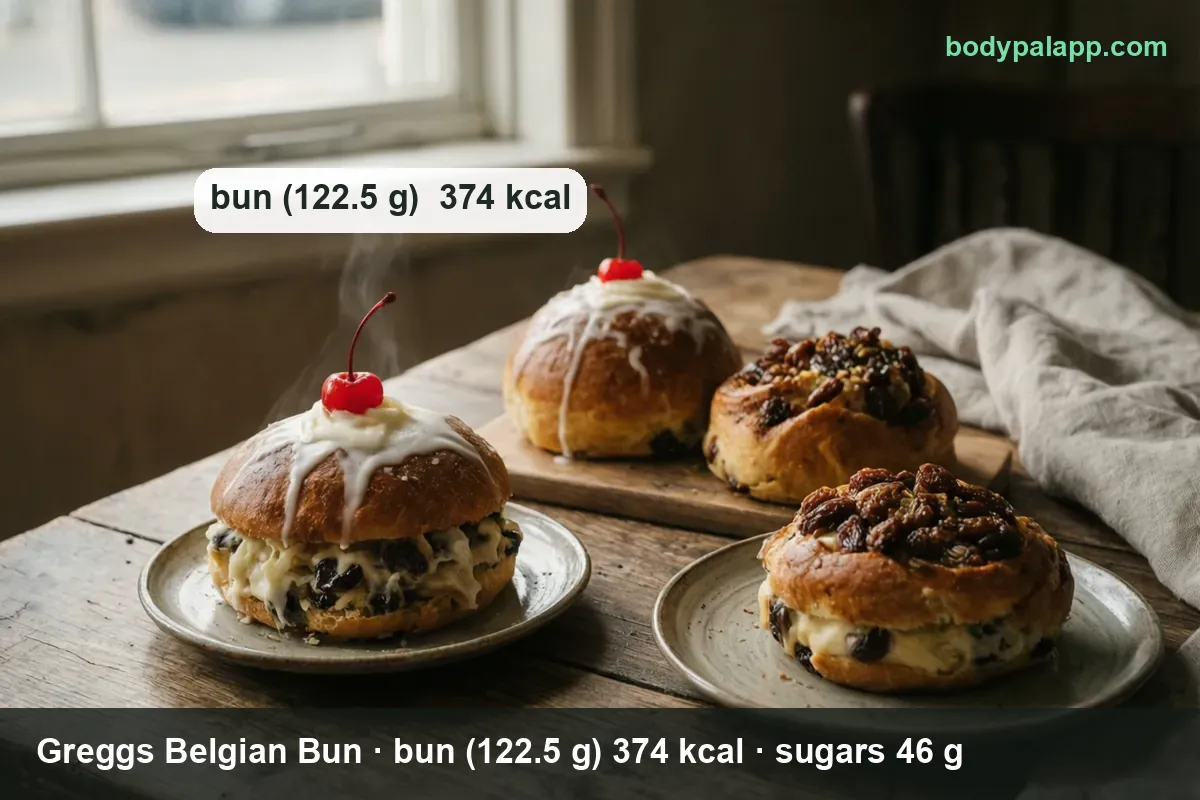
Set against the standard UK sweet bakes on a per-100 g basis, using government composition data, the Belgian Bun is an outlier in two directions at once.
| Per 100 g | Calories | Sugars | Fat | Saturates | Salt |
|---|---|---|---|---|---|
| Greggs Belgian Bun | 305 kcal | 37 g | 2.6 g | 0.9 g | 0.41 g |
| Iced buns, retail | 322 kcal | 25.8 g | 7.8 g | 3.62 g | 0.57 g |
| Chelsea buns | 361 kcal | 21.0 g | 12.5 g | 4.08 g | 0.35 g |
| Hot cross bun | 312 kcal | 23.4 g | 5.8 g | 1.95 g | 0.19 g |
| Currant buns, retail | 280 kcal | 16.0 g | 5.6 g | 1.86 g | 0.575 g |
| Iced ring doughnut | 413 kcal | 16.2 g | 25.7 g | 14.14 g | 0.815 g |
| Scone, plain | 346 kcal | 12.7 g | 12.3 g | 6.37 g | 1.48 g |
| Danish pastry | 446 kcal | 17.3 g | 29.2 g | 11.83 g | 0.583 g |
Highest sugar in the group and lowest fat in the group, by clear margins on both. At 37 g of sugar per 100 g it beats the iced bun at 25.8, the hot cross bun at 23.4, and even the iced ring doughnut at 16.2. At 2.6 g of fat it is under every other line, including the currant bun. The jam doughnut carries five times the fat.
That is why the calorie total stays moderate despite the sugar. Fat delivers nine calories a gram against sugar's four, so a product that swaps fat for sugar lands lower on calories and much higher on sugar. The Belgian Bun does exactly that.
The salt line is the quiet surprise in the other direction. At 0.5 g per bun the Belgian Bun really is negligible on salt, but sweet does not automatically mean unsalted: a plain retail scone runs at 1.48 g of salt per 100 g, so a scone the same weight as this bun would carry over 1.8 g. The bun is the exception on that row, not the rule.
Why there is no fibre line
The quick facts table above has no fibre row, and that is not an omission on our side. Greggs does not publish fibre for this product.
Under UK law, the mandatory nutrition declaration covers energy, fat, saturates, carbohydrate, sugars, protein and salt. Fibre is optional, and plenty of manufacturers leave it off. Rather than guess a number from a similar bun, the row has been removed. Any fibre in a Belgian Bun comes from the wheat flour and the sultanas, and on a white enriched dough it will not be a large figure, but nobody has published what it is.
Most popular Greggs products in the United Kingdom
Ranked by how widely each product appears among foods sold in the United Kingdom, from the BodyPal food database of over 3.3 million products. Calories are the figures printed on each label. Per 100 g the Belgian Bun sits below the savouries, but the bun is heavier than either bake, which is how it ends up ahead of the sausage roll on the till receipt.
| Product | Calories (per 100 g) |
|---|---|
| Greggs Cinnamon Bun | 426 kcal |
| Greggs Iced Ring Doughnut | 348 kcal |
| Greggs Sausage Roll | 337 kcal |
| Greggs Belgian Bun | 305 kcal |
| Greggs Steak Bake | 301 kcal |
| Greggs Chicken Bake | 283 kcal |
Brand popularity: BodyPal food database. Nutrition: manufacturer labels.
Greggs Belgian Bun FAQs
How many calories are in a Greggs Belgian Bun?
374 calories for one bun, which weighs 122.5 g, and 305 calories per 100 g. That is 18.7% of an adult's daily reference intake. Half a bun is 187 calories. The figures come from Greggs' own published nutrition table.
How much sugar is in a Greggs Belgian Bun?
46 g of total sugars in one bun, or 37 g per 100 g. That is 51% of the reference intake for total sugars printed on packs, and more than the 30 g daily limit the NHS sets for free sugars. Fondant icing, apricot jam and soaked sultanas all contribute.
How much does a Greggs Belgian Bun weigh?
122.5 g, which Greggs states in its own nutrition table. That makes it noticeably larger than a supermarket Belgian bun, which typically runs between 95 g and 110 g, and it is the main reason the Greggs bun has the highest calorie total per item despite the leanest recipe per 100 g.
Does a Belgian bun have more calories than a sausage roll?
Yes. A Greggs Belgian Bun is 374 calories against 347 for a sausage roll, a difference of 27. The bun wins on size, at 122.5 g against 103 g, since per 100 g the sausage roll is denser at 337 versus 305. The roll carries 24 g of fat and no sugar; the bun carries 3.2 g of fat and 46 g of sugar.
Is a Belgian bun healthier than a doughnut?
It depends on the metric. A Greggs Glazed Ring Doughnut is 204 calories and 13 g of sugar against the bun's 374 and 46 g, so the doughnut is the lighter choice on both. Per 100 g the picture flips: an iced ring doughnut carries 25.7 g of fat against the bun's 2.6 g.
What is in a Belgian bun?
A soft enriched fruit dough with lemon-flavoured pieces, soaked sultanas and apricot jam, finished with fondant icing and a glace cherry. Fondant icing is 88.9 g of sugar per 100 g, jam 69.3 g and sultanas 69.4 g, which is where the 46 g of sugar in a single bun comes from.
How many calories are in a Tesco Belgian bun?
364 calories for a 99.2 g bun, or 367 per 100 g, from the pack label. The Tesco version is denser than the Greggs one, with 13.7 g of fat per 100 g against 2.6 g, but it is a smaller bun, so the per-item total lands 10 calories below Greggs.
What are the allergens in a Greggs Belgian Bun?
Soya, sulphites and wheat, as listed by Greggs for this product. Allergen listings are reviewed by the manufacturer and can change with a recipe update, so check the current product page or in-store information if you are avoiding any of the three.
Similar foods
- Magnum — 230 kcal per Classic stick
- Cornetto — 194 kcal per cone
- Marshmallow — 327 kcal per 100 g
- Lollipop — 31 kcal small
- Babybel Light — 42 kcal per round
- Drumstick lolly — 46 kcal each
Count the bun, not the guess
Photograph what you bought and BodyPal gives you the calories and the sugar for that item, half-eaten portions included.


Want the bigger picture? Calculate your daily calorie needs — your maintenance figure, a target for losing or gaining, and the date you get there.