
How Many Calories in a Tablespoon of Sugar?
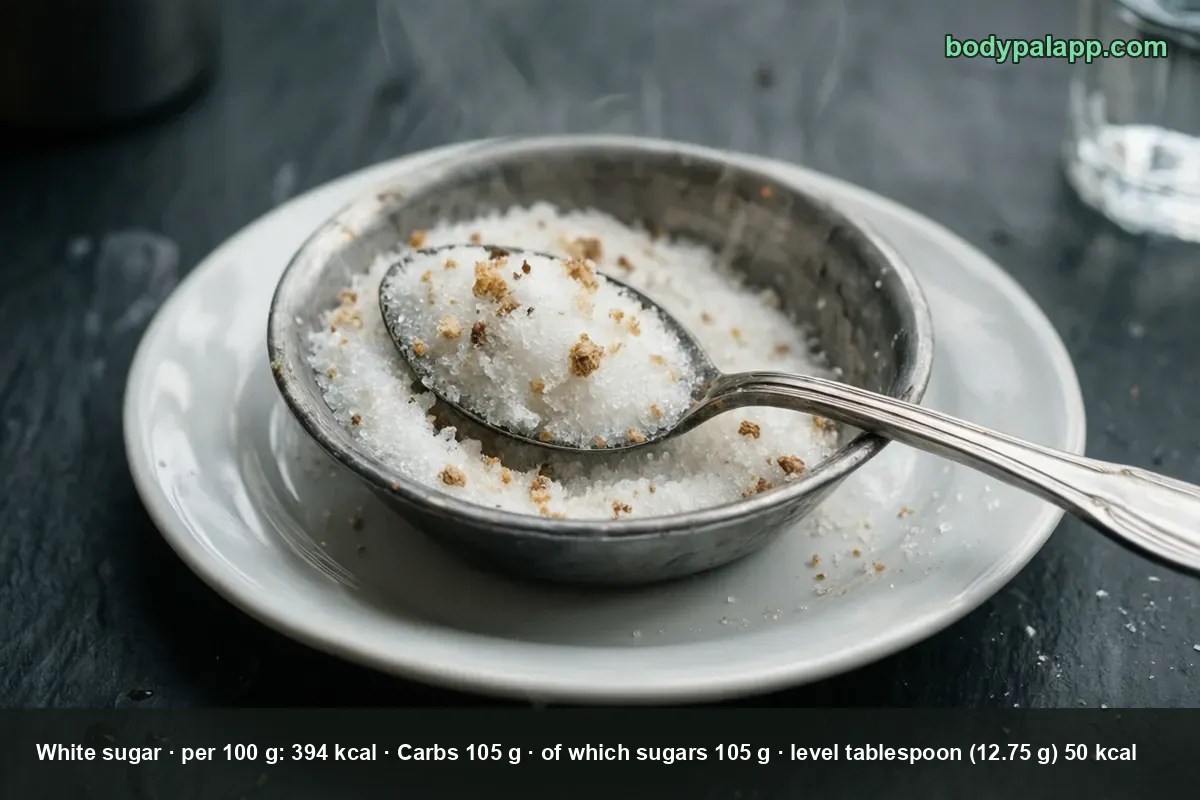
A level UK tablespoon of granulated sugar is 50 calories. It weighs 12.75 g, and 100 g of sugar is 394 kcal. The trouble is the spoon, not the sugar. Heap it, fill it with icing sugar, or borrow a spoon from an Australian recipe, and the same "one tablespoon" lands anywhere between 30 and 100 calories.
On this page
- Tablespoon of sugar quick facts
- How much a tablespoon of sugar weighs
- Level or heaped and why it matters
- The UK US and Australian tablespoon are not the same
- The same spoon with a different sugar
- Brown sugar is heavier not healthier
- What a tablespoon does to the daily sugar limit
- A spoon of sugar against a spoon of honey
- Why the pack says 400 and the tables say 394
- Most popular sugar brands
- FAQ
Tablespoon of sugar quick facts
Figures are for white granulated sugar. The middle column is one level 15 ml UK tablespoon, which weighs 12.75 g.
| Nutrient | Per 100 g | One level tablespoon (12.75 g) | RI%* |
|---|---|---|---|
| Energy | 394 kcal / 1,648 kJ | 50 kcal / 209 kJ | 2.5% |
| Protein | Trace | Trace | – |
| Carbohydrates | 105.0 g | 13.4 g | 5% |
| – of which sugars | 105.0 g | 13.4 g | 15% |
| Fat | 0.0 g | 0.0 g | – |
| – of which saturates | 0.00 g | 0.00 g | – |
| Fibre | 0.0 g | 0.0 g | – |
| Salt | 0.0125 g | 0.002 g | – |
*RI% = one spoon's share of an adult's daily reference intake, based on 2,000 kcal.
One figure in that table looks broken and is not: 105.0 g of carbohydrate in 100 g of sugar. Composition tables express carbohydrate as monosaccharide equivalents. Sucrose has a formula weight of 342.30, and hydrolysing it produces two simple sugars of 180.16 each, so 100 g of sucrose becomes 360.32 divided by 342.30, or 1.0526 times its own weight. The pack in your cupboard skips that step and prints 100 g. On the pack's own basis, a level spoon is 12.75 g of sugars, which is 14% of the 90 g label reference intake rather than 15%.
Verified nutrition data
Numbers on this page come from CoFID, the UK government’s Composition of Foods Integrated Dataset, and from manufacturer labels where a branded product is named. Last verified August 2026. How we verify our data →
How much a tablespoon of sugar weighs
Two numbers make the weight, and both are worth showing because almost nobody shows them.
The first is volume. A UK tablespoon is a metric measure of 15 ml. A teaspoon is 5 ml and a dessertspoon is 10 ml, so three level teaspoons fill one tablespoon exactly.
The second is bulk density, which is where the guessing usually happens. It does not have to. US government portion weights for granulated sugar give two independent readings: one cup weighs 200.0 g, and a US cup is 236.588 ml, so 200 divided by 236.588 is 0.8454 g/ml. The same entry gives 4.2 g per teaspoon, and a US teaspoon is 4.9289 ml, so 4.2 divided by 4.9289 is 0.8521 g/ml. Two different portion sizes, measured separately, agree to within one per cent. The working figure is 0.85 g/ml.
Multiply and you have the answer:
15 ml x 0.85 g/ml = 12.75 g, and 12.75 g at 394 kcal per 100 g is 50 kcal.
The cross-check comes off British packaging. Silver Spoon Granulated Sugar, barcode 5010067301502, declares a serving as "1 teaspoon (4 g)". So does Silver Spoon's standard Sugar, barcode 5010067331509. Our own derivation puts 5 ml at 4.25 g, and the label rounds it to 4. The two methods land on the same spoon.
Published density tables are wider than that, and it pays to know why. The FAO/INFOODS density database lists granulated sugar at 0.70, white sugar at 0.90 from one lab and 0.88 from another, and plain "sugar" at 0.95. Those come from different laboratories using different degrees of settling, from loosely poured to tapped down. A kitchen spoon dipped into a bag sits in the middle of that spread, which is exactly where the portion weights put it.
Level or heaped and why it matters
Level means scraped flat with the back of a knife. It is the only version of a tablespoon anyone has defined.
| Measure | Volume | Weight | Calories |
|---|---|---|---|
| Level teaspoon | 5 ml | 4.25 g | 17 kcal |
| Two teaspoons, the standard brew | 10 ml | 8.50 g | 33 kcal |
| Level dessertspoon | 10 ml | 8.50 g | 33 kcal |
| Level UK tablespoon | 15 ml | 12.75 g | 50 kcal |
| Two level tablespoons | 30 ml | 25.50 g | 100 kcal |
| Heaped tablespoon | ~22-30 ml | 19-25 g | 75-100 kcal |
A heaped tablespoon has no standard behind it. No British standard, no food agency and no international food code defines one. Kitchen convention treats the heap as one and a half to two times the level volume, which is why the row above is a range and not a single figure. A heaped spoon of sugar is somewhere between 75 and 100 kcal, and anyone quoting it to the calorie is guessing.
That range is larger than every other variable on this page. If you want a number you can trust, level the spoon.
The UK US and Australian tablespoon are not the same
People worry about the wrong one. The American tablespoon is half a US fluid ounce, or 14.7868 ml, against the British 15 ml. Australia and New Zealand use 20 ml, which is four teaspoons rather than three.
Take a recipe calling for two tablespoons of sugar:
| Where the recipe was written | Volume | Weight | Calories |
|---|---|---|---|
| UK, EU and Canada (15 ml) | 30 ml | 25.5 g | 100 kcal |
| US (14.7868 ml) | 29.6 ml | 25.1 g | 99 kcal |
| Australia and New Zealand (20 ml) | 40 ml | 34.0 g | 134 kcal |
The transatlantic gap is one calorie. It is not worth a second thought, and the internet spends a great deal of energy on it anyway.
The Australian gap is 34%. Bake an Australian recipe with a British spoon and you are short a third of the sugar it was written for; run it the other way and you add a third more than intended. That is the one case where the country of the spoon changes the result, and it is the case nobody flags.
The same spoon with a different sugar
Here is the finding that surprises people. Identical spoon, identical technique, and the calories move by half, because sugars pack at very different densities.
| Sugar | Density | One level UK tablespoon | Calories |
|---|---|---|---|
| Granulated | 0.85 g/ml | 12.75 g | 50 kcal |
| Caster | approx 0.85 g/ml | approx 12.8 g | approx 50 kcal |
| Demerara | approx 0.85 g/ml | approx 12.75 g | 50 kcal |
| Icing, unsifted | 0.51 g/ml | 7.6 g | 30 kcal |
| Brown soft, packed | 0.930 g/ml | 13.95 g | 53 kcal |
| Brown soft, unpacked | 0.613 g/ml | 9.19 g | 35 kcal |
Icing sugar against granulated is 30 kcal against 50, a drop of 40% for the same spoon. Milled to a powder, sucrose traps air between particles and one tablespoon holds barely 7.6 g of it. Nothing about the sugar changed. Per gram, icing sugar is 393 kcal per 100 g against granulated's 394.
Brown sugar swings the other way, and it swings on how you load the spoon. Pressed down, it is 13.95 g and 53 kcal; spooned in loose, it is 9.19 g and 35 kcal. That is a 51% difference in one ingredient, and it is the entire reason baking recipes say "packed brown sugar" instead of just "brown sugar".
Caster sugar is the one people expect to differ and it does not. It is the same sucrose as granulated sugar with a smaller crystal, so gram for gram the two are identical at roughly 400 kcal per 100 g on the pack. Use the same 12.75 g for the spoon unless you are weighing it.
Brown sugar is heavier not healthier
Brown sugar does carry more minerals than white, and the ratios look impressive. Per 100 g it has 1.70 mg of iron against white sugar's 0.20 mg, and 140 mg of potassium against 5 mg. Iron is eight and a half times higher. Potassium is twenty-eight times higher.
Now put it in a spoon. A packed tablespoon is 13.95 g, which carries 0.24 mg of iron, or 1.7% of the 14 mg nutrient reference value. The multiplier is real and the amount is not.
The calorie side is worse than the myth suggests. Brown sugar is 380 kcal per 100 g against white sugar's 394, so per gram it is 3.6% lighter. But its packed spoon weighs more, 13.95 g against 12.75 g, so a packed tablespoon of brown sugar carries 53 kcal against white sugar's 50. Swapping white for brown in your tea puts calories up, not down.
What a tablespoon does to the daily sugar limit
UK government dietary recommendations cap free sugars at under 33 g a day for men and under 27 g for women aged 19 to 64. Children get less: under 20 g for boys aged 4 to 6 and under 18 g for girls, rising to 24 g and 23 g at ages 7 to 10.
Against that, one level tablespoon of sugar is 39% of a man's daily limit and 47% of a woman's. Two spoons are 77% and 94%. A child aged 4 to 6 reaches the whole day's allowance in about one and a half tablespoons.
The label tells a gentler story for the same 12.75 g, and this is where people get confused. Pack reference intakes use a 90 g figure for total sugars, so a spoon reads as 14% of your day. The government limit is for free sugars only, and it sits at roughly a third of that base. Same spoon, 14% or 39%, depending on which yardstick is printed. The NHS advice on cutting down on sugar uses the stricter one.
Two teaspoons in a cup of tea is 8.5 g of sugar and 33 kcal. Four mugs across a working day is 34 g of sugar and 134 kcal, which clears the daily free sugars limit for a man and comfortably clears it for a woman before you eat anything at all. A tablespoon stirred through porridge adds the same 50 kcal it adds anywhere else, on top of whatever the oats bring.
A spoon of sugar against a spoon of honey
| Sweetener or drink | Per 100 g or 100 ml | Per portion |
|---|---|---|
| Granulated sugar | 394 kcal | 50 kcal (level tbsp, 12.75 g) |
| Caster sugar | 394 kcal | 50 kcal (level tbsp, 12.8 g) |
| Honey | 288 kcal | 62 kcal (level tbsp, 21.4 g) |
| Coke | 41 kcal per 100 ml | 135 kcal (330 ml can) |
Honey makes the point of this whole page better than sugar does. Per gram, honey is lighter than sugar: 288 kcal per 100 g against 394, which is 27% less. Per spoon it is heavier. Honey's density is 1.43 g/ml, so a 15 ml tablespoon holds 21.4 g of it and comes to 62 kcal, 24% more than a spoon of sugar. The food got lighter and the spoon got heavier, and the spoon won.
The verdict for anyone counting: if you are sweetening by the spoon, sugar is the smaller number and honey is not the healthier swap it is sold as. If you are counting drinks instead, a 330 ml can of cola carries 35.97 g of sugars, which is 2.8 level tablespoons poured into a glass, and that single can beats a whole day's free sugars allowance. Cutting one can does more than cutting one spoon, roughly three times more.
Why the pack says 400 and the tables say 394
Look up sugar in two places and you get two numbers. Composition tables say 394 kcal per 100 g. The bag says 400. Neither is wrong.
Composition tables run the monosaccharide conversion first, giving 105.0 g of carbohydrate, then apply 3.75 kcal per gram to it: 105.0 x 3.75 = 393.75, rounded to 394. Food labels use the simpler legal route, 100 g of carbohydrate at 4 kcal per gram, which is 400. The kilojoule lines split the same way, 105.0 x 16 = 1,680 against the label's 100 x 17 = 1,700.
On a tablespoon that entire argument is worth 0.8 kcal. Round it however you like.
Brand makes even less difference. Across the British shelf, white, caster and icing sugars sit between 399 and 403 kcal per 100 g, a spread under one calorie per spoon. Only the soft brown and muscovado sugars drop lower, to 378-393 kcal per 100 g, and that is water in the molasses rather than anything lighter. The 30 to 53 kcal range in a tablespoon comes from density alone, which is why a set of scales beats a set of spoons on every day that accuracy matters. The Eatwell Guide puts sugary foods outside the main plate for the same reason: the amounts are small and they add up quietly.
Most popular sugar brands in the United Kingdom
Ranked by how widely each product appears among foods sold in the United Kingdom, from the BodyPal food database of over 3.3 million products. Calories are the figures printed on each label. The whole shelf sits inside a 22-calorie band per 100 g, so the spoon you use matters far more than the bag you buy.
| Product | Calories (per 100 g) |
|---|---|
| Tate & Lyle Pure Cane Granulated Sugar | 400 kcal |
| Tate & Lyle Golden Caster Sugar | 399 kcal |
| Tesco Demerara Sugar | 398 kcal |
| Billington's Demerara Unrefined Cane Sugar | 398 kcal |
| Tate & Lyle Light Soft Brown Sugar | 384 kcal |
| Tate & Lyle Dark Soft Brown Cane Sugar | 378 kcal |
Brand popularity: BodyPal food database. Nutrition: manufacturer labels.
Tablespoon of sugar FAQs
How many calories in a tablespoon of sugar?
50 kcal for a level 15 ml UK tablespoon of granulated sugar, which weighs 12.75 g. A heaped tablespoon is 19 to 25 g and runs 75 to 100 kcal. An Australian 20 ml tablespoon holds 17 g and comes to 67 kcal.
How many grams is a tablespoon of sugar?
12.75 g, level. A UK tablespoon is 15 ml and granulated sugar has a bulk density of about 0.85 g/ml, taken from two US portion weights that agree closely: 200 g per cup and 4.2 g per teaspoon. British packs declare a teaspoon as 4 g, which matches.
How many teaspoons in a tablespoon of sugar?
Three. A UK teaspoon is 5 ml and a UK tablespoon is 15 ml, so three level teaspoons of 4.25 g each fill one 12.75 g tablespoon. The Australian tablespoon is the exception, at 20 ml and four teaspoons.
How many calories in a teaspoon of sugar?
17 kcal for a level 5 ml teaspoon, which weighs 4.25 g. Two teaspoons, the usual measure in a mug of tea or coffee, come to 8.5 g of sugar and 33 kcal. Four such mugs across a day total 34 g of sugar.
Is a UK tablespoon the same as a US tablespoon?
Almost. A UK tablespoon is 15 ml and a US tablespoon is 14.7868 ml, so the sugar weighs 12.75 g against 12.57 g and both round to 50 kcal. The difference that does matter is Australian, where a 20 ml tablespoon holds 34% more.
How many calories in a tablespoon of brown sugar?
53 kcal packed and 35 kcal loose. Soft brown sugar is 380 kcal per 100 g, lighter per gram than white sugar's 394, but a packed spoon holds 13.95 g against white sugar's 12.75 g. Packed brown sugar therefore beats white on calories, 53 against 50.
How many tablespoons of sugar in a can of Coke?
2.8 level tablespoons. A 330 ml can carries 35.97 g of sugars at 10.9 g per 100 ml, and one level tablespoon of granulated sugar is 12.75 g. The can also comes to 135 kcal, against 50 kcal for a single spoon.
How many calories in 2 tablespoons of sugar?
100 kcal, from 25.5 g of sugar. That is 77% of the daily free sugars limit for a man and 94% of the limit for a woman. Two heaped tablespoons would be 38 to 50 g of sugar, over the limit for either.
Similar foods
- Caster sugar — 16 kcal per level teaspoon
- Granulated sugar — 16 kcal per level teaspoon
- Cheddar cheese — 125 kcal per 30 g piece
- Brie — 103 kcal per 30 g wedge
- Hummus — 92 kcal per 30 g
- Chia seeds — 58 kcal a tablespoon
Count the spoon without weighing it
Photograph what went into the bowl and BodyPal works out the number for that spoonful rather than a standard one.


One food is easy to picture; a whole day is harder. See how many calories you need a day and what a deficit actually looks like.