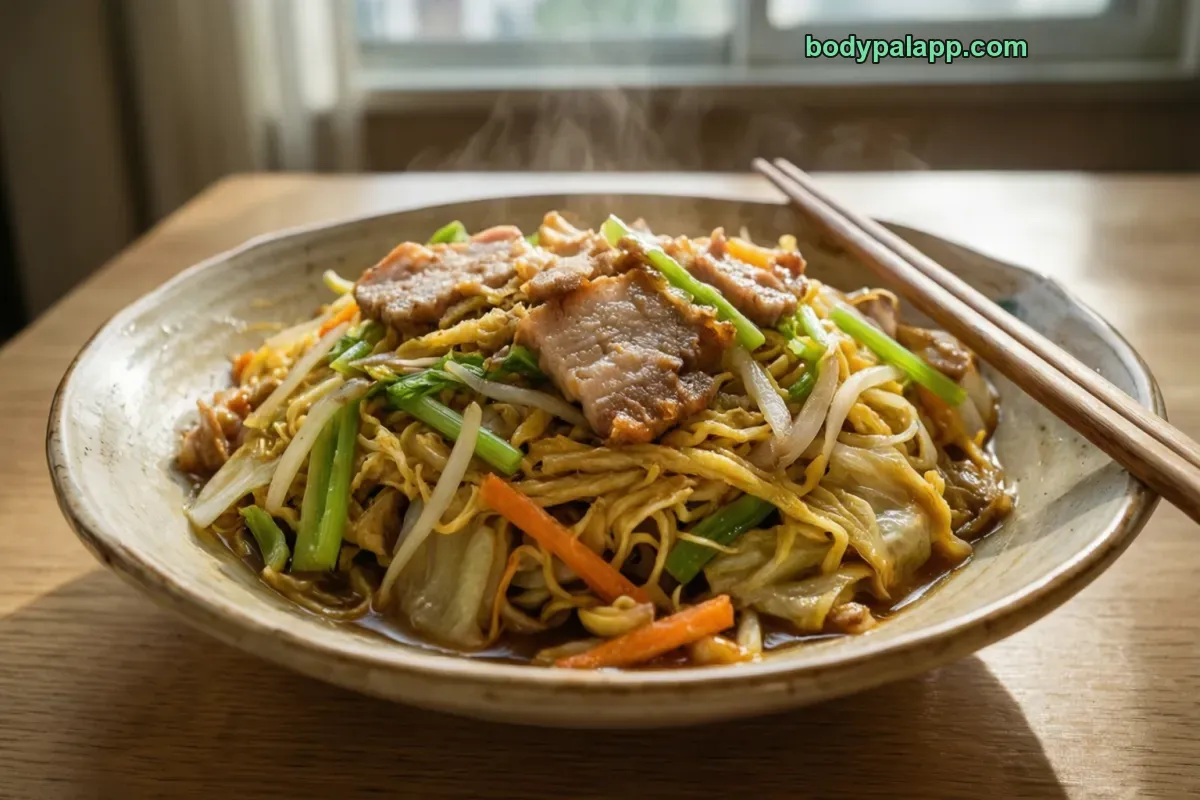
Pork chow mein calories come to 315 for 1 cup (220 g) and 143 per 100 g, based on the USDA row for pork chow mein or chop suey with noodles. The noodles matter most: the same cup without them drops to 216 calories. Fat, not carbs, supplies the largest share of the energy.
315kcal
1 cup · 220 g, with noodles
29%protein
23 gProtein
25 gCarbs
14 gFat
How to burn off 315 kcal
—Walking, brisk
—Jogging
—Cycling, moderate
—Swimming
Skip the math. BodyPal counts these calories from your steps and workouts automatically.
Nutrition facts
With noodles · per 220 g
Calories
315 kcal
Protein
23 g
Carbohydrate
25 g
Fat
14 g
Saturated fat
4.4 g
Cholesterol
51 mg
Sodium
715 mg
Potassium
475 mg
Iron
3 mg
Source: USDA FoodData Central
🛡️
Verified nutrition data
Numbers on this page come from USDA FoodData Central, the U.S. Department of Agriculture’s food composition database, and from manufacturer labels where a branded product is named. Last verified October 2026. How we verify our data →
Pork chow mein: calories, protein and sodium by serving
Percent of daily value uses the FDA reference of 2,000 kcal a day.
Serving
kcal
Protein
Carbs
Fat
Sodium
% DV kcal
1 cup (220 g)
315
22.9 g
24.6 g
14 g
715 mg
16%
No noodles, 1 cup (220 g)
216
22.7 g
8.5 g
9.5 g
550 mg
11%
100 g
143
10.4 g
11.2 g
6.4 g
325 mg
7%
3 × 1 cup (220 g)
944
68.7 g
2,145 mg
5 × 1 cup (220 g)
1,573
114.5 g
3,575 mg
One cup is 315 calories, a big plate is far more
A 1 cup (220 g) serving of pork chow mein with noodles holds 315 calories, 16% of a 2,000-calorie daily value. That cup also carries 22.9 g of protein, 24.6 g of carbs and 14 g of fat. On its own it is a reasonable plate. The trouble is that few people stop at one cup.
Two cups come to 629 calories and 45.8 g of protein. Three cups, an easy amount to serve yourself from a big shared container, reach 944 calories and 68.7 g of protein. Eat five cups over a long family-style dinner and you are at 1,573 calories and 114.5 g of protein. The protein looks impressive at that size, but so does everything else on the label.
The easiest control is the measuring cup itself. Scoop a single cup onto the plate, fill the rest with something lighter, and the total stays predictable. If you would rather not measure at all, BodyPal can log the dish from a photo.
Fat supplies 40% of the calories
Per 100 g, pork chow mein has 10.4 g of protein, 11.2 g of carbs and 6.4 g of fat. Those grams look balanced. Turn them into calories and the split is 29% protein, 31% carbs and 40% fat.
So in energy terms this is not mainly a noodle dish. Cooking oil and the pork push fat to the top, while the noodles and vegetables supply most of the carbs. Saturated fat sits at 2 g per 100 g, and cholesterol is 23 mg.
The protein share is the strong point. A single cup gives 22.9 g, which is 46% of the 50 g daily value, a solid number for a noodle dish. Fiber is modest at 1.5 g per 100 g and sugars are low at 1.6 g, so the dish leans savory and rich rather than sweet.
Sodium is the row to watch
Every 100 g carries 325 mg of sodium, 14% of the 2,300 mg daily value. A 1 cup (220 g) serving has 715 mg, which is 31% of the day in one scoop. That is nearly double the calorie share of 16%, so the salt arrives faster than the energy.
Portions multiply it. Two cups bring 1,430 mg and three cups 2,145 mg, close to the whole daily value. Five cups reach 3,575 mg, well past it. Any extra sauce poured at the table only adds to these numbers.
If you watch sodium, the no-noodle version helps a little at 550 mg per cup, or 24% of the daily value. Potassium is 216 mg per 100 g. The simpler fix is keeping one cup as the portion and planning lower-salt meals around it.
Without noodles, a cup drops to 216 calories
The USDA lists a separate row for pork chow mein without noodles, and the gap is clear. A 1 cup (220 g) serving falls to 216 calories, 11% of the daily value, from 315 with noodles. Carbs drop from 24.6 g to 8.5 g, and fat falls from 14 g to 9.5 g.
Protein barely moves: 22.7 g versus 22.9 g, or 45% against 46% of the daily value. That makes the no-noodle bowl the better choice if you want the most protein per calorie. Fiber does fall, from 3.3 g to 1.8 g, and sugars edge up to 3.9 g from 3.4 g.
For a fuller plate either way, add steamed vegetables or a broth-based side rather than fried rice or egg rolls. That keeps the meal built around the pork and vegetables instead of stacking a second starch on top of the noodles.
How does pork chow mein compare?
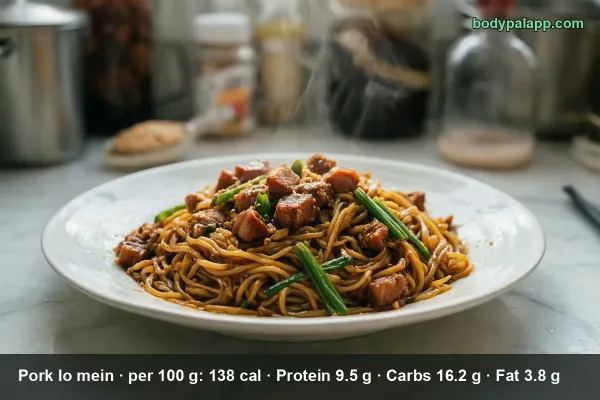
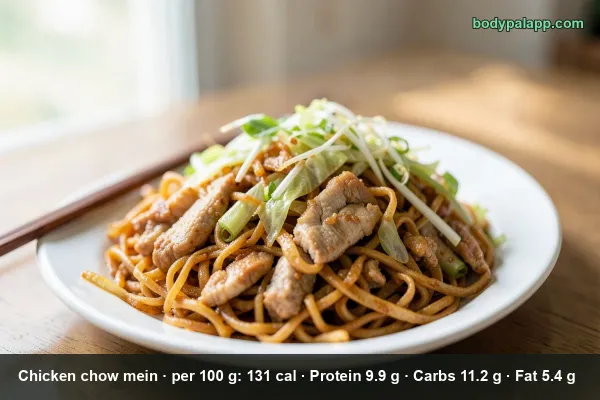
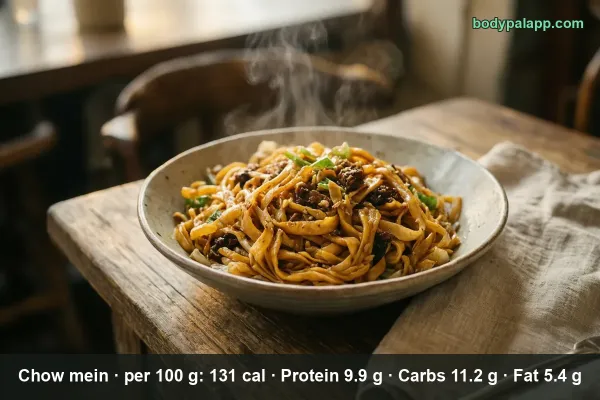
Here is how pork chow mein stacks up against pork lo mein, chicken chow mein and plain chow mein, per 100 g and per usual serving.
Verdict: For the fewest calories pick chicken chow mein at 131 per 100 g, though it carries more sodium at 408 mg. Pork lo mein has the least fat at 3.8 g but the most carbs at 16.2 g, so pork chow mein stays ahead on protein against both.
Pork chow mein FAQs
How many calories are in a cup of pork chow mein?
A cup of pork chow mein with noodles (220 g) has about 315 calories. The same cup without noodles has about 216 calories.
Is pork chow mein good for weight loss?
Pork chow mein has 143 calories per 100 g, and a 220 g cup brings 22.9 g of protein and 14.0 g of fat. Leaving out the noodles lowers a cup to about 216 calories.
Pork chow mein vs pork lo mein: which has fewer calories?
Pork lo mein is slightly lower at 138 calories per 100 g, against 143 for pork chow mein. Pork chow mein has more protein, 10.4 g per 100 g versus 9.5 g.
How much protein is in pork chow mein?
A cup of pork chow mein (220 g) has about 22.9 g of protein and 24.6 g of carbs. It also carries about 715 mg of sodium per cup.
How many calories are in pork chow mein without noodles?
A 1 cup (220 g) serving of pork chow mein without noodles has 216 calories, compared with 315 for the version with noodles. It keeps 22.7 g of protein and drops carbs to 8.5 g.
How much sodium is in a cup of pork chow mein?
One cup (220 g) has 715 mg of sodium, 31% of the 2,300 mg daily value. Per 100 g the figure is 325 mg, and two cups reach 1,430 mg.
How many carbs are in pork chow mein?
A cup (220 g) holds 24.6 g of carbs, with 3.3 g of fiber and 3.4 g of sugars. Per 100 g that is 11.2 g, and carbs supply 31% of the dish's calories.
Does pork chow mein have more calories than chicken chow mein?
Slightly. Pork chow mein has 143 calories per 100 g versus 131 for chicken chow mein. Chicken has a bit less fat at 5.4 g against 6.4 g, but more sodium at 408 mg against 325 mg.