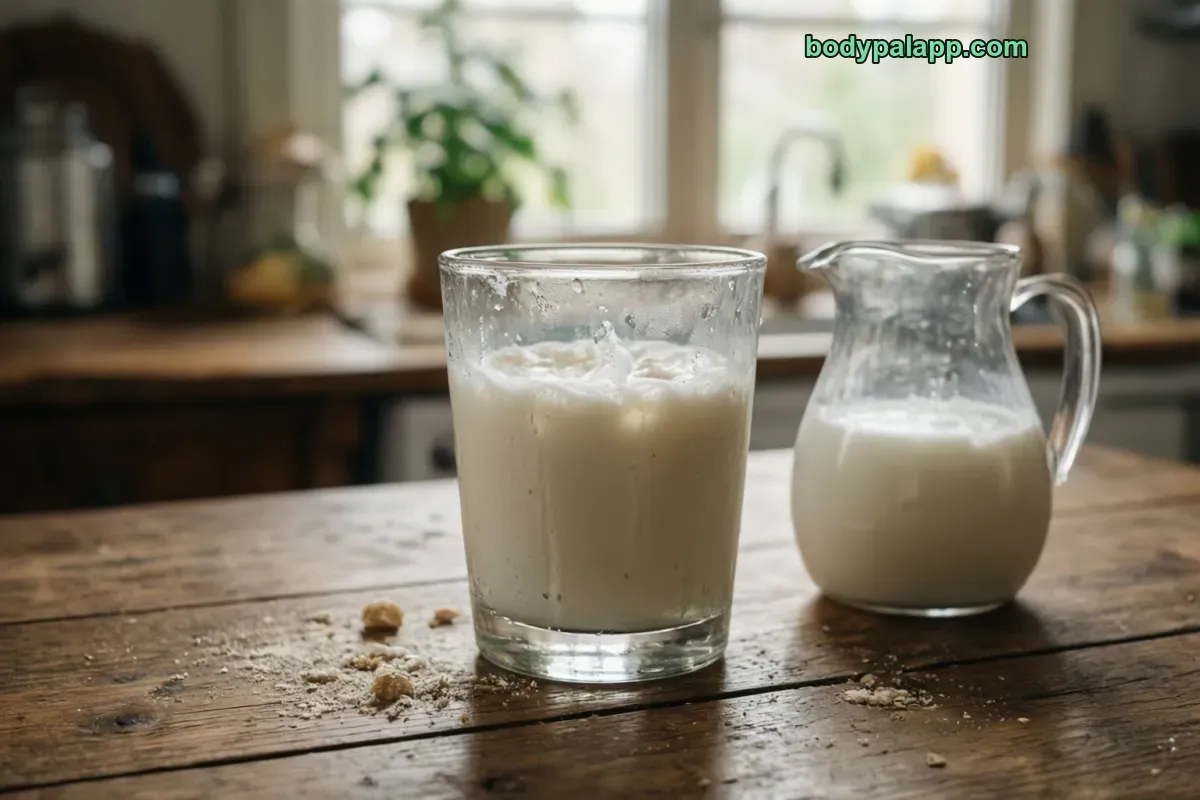
Buttermilk calories come to 98 for 1 cup (245 g) of cultured low-fat buttermilk, or 40 per 100 g. Look at the sodium first. That cup carries 363 mg, 16% of the daily value, which is a much bigger share than its 5% of daily calories and far more salt than plain milk has.
98kcal
1 cup · 245 g, cultured, low-fat
32%protein
8.1 gProtein
12 gCarbs
2.6 gFat
How to burn off 98 kcal
—Walking, brisk
—Jogging
—Cycling, moderate
—Swimming
Skip the math. BodyPal counts these calories from your steps and workouts automatically.
Nutrition facts
Cultured, low-fat · per 245 g
Calories
98 kcal
Protein
8.1 g
Carbohydrate
11.7 g
Fat
2.6 g
Saturated fat
1.6 g
Cholesterol
10 mg
Sodium
363 mg
Potassium
370 mg
Iron
0.1 mg
Source: USDA FoodData Central
🛡️
Verified nutrition data
Numbers on this page come from USDA FoodData Central, the U.S. Department of Agriculture’s food composition database, and from manufacturer labels where a branded product is named. Last verified October 2026. How we verify our data →
Buttermilk: calories, protein and sodium by serving
Percent of daily value uses the FDA reference of 2,000 kcal a day.
Serving
kcal
Protein
Carbs
Fat
Sodium
% DV kcal
1 cup (245 g)
98
8.1 g
11.7 g
2.6 g
363 mg
5%
Whole, 1 cup (245 g)
152
7.9 g
12 g
8.1 g
257 mg
8%
100 g
40
3.3 g
4.8 g
1.1 g
148 mg
2%
3 × 1 cup (245 g)
294
24.3 g
1,088 mg
5 × 1 cup (245 g)
490
40.5 g
1,813 mg
One cup is 98 calories, whole buttermilk is 152
A standard 1 cup (245 g) pour of low-fat cultured buttermilk comes to 98 calories, 5% of a 2000-calorie day. It brings 8.1 g of protein, 11.7 g of carbs and 2.6 g of fat. For dairy, that is a light drink, and it barely moves your total whether you add it to breakfast or a marinade.
The total rises in a straight line. Two cups (490 g) come to 196 calories, three cups (735 g) to 294, and five cups (1,225 g) reach 490. A big batch of biscuits or a chicken brine can call for that much, but very little of it ends up in one serving of the finished dish. Log what you actually eat, not what went into the bowl.
The type on the label matters more than how much you pour. Whole buttermilk comes to 152 calories per 1 cup (245 g), with 8.1 g of fat against 2.6 g in the low-fat version. Protein barely changes, at 7.9 g versus 8.1 g. If the carton does not say low-fat, check it before you log.
Carbs lead, protein is close behind
Per 100 g, buttermilk has 3.3 g of protein, 4.8 g of carbs and 1.1 g of fat. By calories, carbs supply 46%, protein 32% and fat 23%. For something you drink, getting about a third of the energy from protein is a solid share.
Nearly all of the carbs are sugar. The sugar row reads 5.4 g per 100 g and 13.1 g per cup, and the fiber row reads 0 g. If you track carbs or sugar, count buttermilk the same way you would count milk. Its tangy taste can make it seem less sweet than the numbers say.
Fat is the smallest slice. A cup has 2.6 g of fat in total, and saturated fat comes to 0.7 g per 100 g, so the low-fat label holds up. Cholesterol is just 4 mg per 100 g, against a daily value of 300 mg. If you are cutting saturated fat, the low-fat carton is the clear pick over whole.
Sodium is the row to watch
For a glass of dairy, buttermilk is saltier than you might expect. At 148 mg per 100 g, a cup carries 363 mg of sodium, 16% of the 2300 mg daily value. The same cup is only 5% of your calories, so it uses up much more of your sodium budget than your calorie budget.
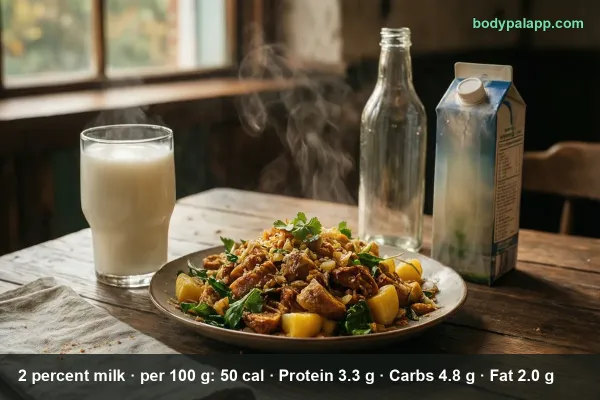
Next to 2 percent milk, the gap is clear. That milk lists 47 mg of sodium per 100 g, so buttermilk has roughly three times as much while having fewer calories, 40 versus 50 per 100 g. Choosing buttermilk to save calories means taking on more salt.
It adds up when you have more than one serving: 2 cups bring 725 mg, 3 cups 1,088 mg and 5 cups 1,813 mg. If you watch sodium, count this when buttermilk goes into biscuits, pancakes or fried chicken batter, because those recipes usually add salt too. Oddly, whole buttermilk lists less sodium, at 257 mg per cup or 11% of the daily value.
A lean base that stands in for richer dairy
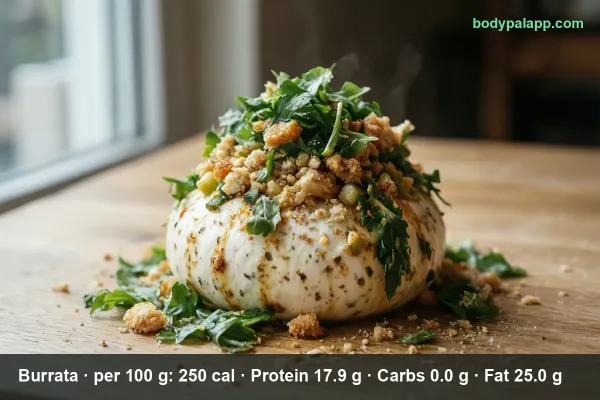
With only 98 calories and 8.1 g of protein per cup, buttermilk makes a light base for smoothies, overnight oats or a tangy dressing. Using it in place of richer dairy cuts a lot of calories. Burrata, a creamy fresh cheese, comes to 250 calories per 100 g, compared with 40 for buttermilk.
It adds some potassium too, 151 mg per 100 g against a daily value of 4700 mg. Buttermilk has no fiber, so pair it with fruit, oats or whole-grain bread to make it more filling. Eggs or a handful of nuts with it make a breakfast that keeps you full longer.
Pancakes and biscuits are a different story, because there the buttermilk is a small part of the calories. The flour, butter and syrup add far more. If you photograph your plate, BodyPal can log it from the picture, and you can then set the buttermilk amount to the cup you actually used.
How does buttermilk compare?
Here is how buttermilk compares with 2 percent milk, breast milk and burrata, per 100 g and per usual serving.
Verdict: For the fewest calories, choose buttermilk at 40 per 100 g, compared with 50 for 2 percent milk, 70 for breast milk and 250 for burrata. If sodium is your concern, choose 2 percent milk at 47 mg per 100 g. If you want the most protein per bite, burrata has 17.9 g but 6.3 times the calories.
Buttermilk FAQs
How many calories are in a cup of buttermilk?
A cup (245 g) of low-fat cultured buttermilk has 98 calories. The same cup of whole buttermilk has 152.
Is buttermilk good for weight loss?
Low-fat buttermilk has 40 calories and 1.1 g fat per 100 g, so a full cup is 98 calories with 8.1 g protein.
Buttermilk vs 2% milk: which has fewer calories?
Per 100 g, low-fat buttermilk has 40 calories and 2% milk has 50.
How much protein and sugar is in buttermilk?
A cup of low-fat buttermilk has 8.1 g protein and 13.1 g sugars, or 3.3 g protein per 100 g.
How many calories are in whole buttermilk?
Whole buttermilk has 152 calories per 1 cup (245 g), compared with 98 for low-fat cultured buttermilk. Most of the gap is fat, 8.1 g versus 2.6 g, while protein barely changes at 7.9 g versus 8.1 g.
How much sodium is in a cup of buttermilk?
A cup (245 g) of low-fat buttermilk has 363 mg of sodium, 16% of the daily value. That works out to 148 mg per 100 g, roughly three times the 47 mg in 2 percent milk.
How many calories are in 100 g of buttermilk?
100 g of low-fat cultured buttermilk has 40 calories, with 3.3 g of protein, 4.8 g of carbs and 1.1 g of fat. That is lighter than 2 percent milk, which has 50 calories per 100 g.
How many calories are in 2 cups of buttermilk?
Two cups (490 g) of low-fat buttermilk come to 196 calories, with 16.2 g of protein and 725 mg of sodium. Three cups (735 g) come to 294 calories and 1,088 mg of sodium.
Does buttermilk have fewer calories than breast milk?
Yes. Buttermilk has 40 calories per 100 g, while breast milk has 70, about 1.8 times as much. Buttermilk also has more protein, 3.3 g versus 1 g per 100 g, and less fat, 1.1 g versus 4.4 g.