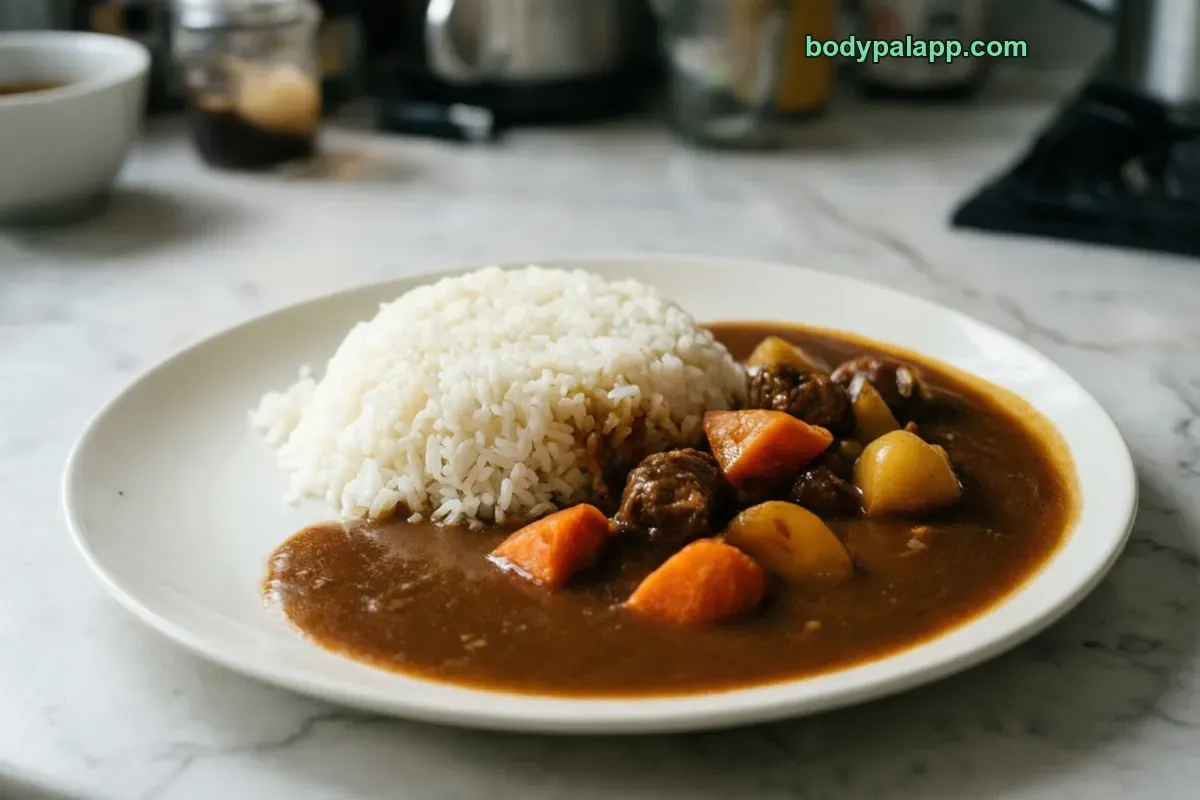
Curry rice calories come to 232 for one cup (200 g) of chicken curry with rice, and 116 per 100 g. The calories are moderate. Sodium is the number to notice: that same cup carries 648 mg, 28% of the daily value. Calories and salt both climb fast once the plate goes past a single cup.
232kcal
1 cup of curry rice · 200 g, chicken curry, with rice
17%protein
9.9 gProtein
30 gCarbs
8 gFat
How to burn off 232 kcal
—Walking, brisk
—Jogging
—Cycling, moderate
—Swimming
Skip the math. BodyPal counts these calories from your steps and workouts automatically.
Nutrition facts
Chicken curry, with rice · per 200 g
Calories
232 kcal
Protein
9.9 g
Carbohydrate
30 g
Fat
8 g
Saturated fat
1.9 g
Cholesterol
26 mg
Sodium
648 mg
Potassium
364 mg
Iron
1.8 mg
Source: USDA FoodData Central
🛡️
Verified nutrition data
Numbers on this page come from USDA FoodData Central, the U.S. Department of Agriculture’s food composition database, and from manufacturer labels where a branded product is named. Last verified September 2026. How we verify our data →
Curry rice: calories, protein and sodium by serving
Percent of daily value uses the FDA reference of 2,000 kcal a day.
Serving
kcal
Protein
Carbs
Fat
Sodium
% DV kcal
1 cup (200 g)
232
9.9 g
30.2 g
8 g
648 mg
12%
Beef version (200 g)
238
11.2 g
30.2 g
8.1 g
628 mg
12%
Lentil version (200 g)
236
6.6 g
37.2 g
7 g
656 mg
12%
100 g
116
5 g
15.1 g
4 g
324 mg
6%
3 × 1 cup (200 g)
696
29.8 g
1,944 mg
5 × 1 cup (200 g)
1,160
49.6 g
3,240 mg
One cup is 232 calories, three cups is 696
A cup of chicken curry with rice weighs about 200 g and lands at 232 calories, which is 12% of the daily value. For a full serving of a cooked meal, that is a modest number. The catch is that curry rice is rarely served in neat single cups.
A generous takeout plate easily holds two cups, and that comes to 464 calories with 19.8 g of protein. Go back for more and three cups reach 696 calories. A five-cup pot, about 1,000 g, adds up to 1,160 calories before anyone divides it up. The total rises in a straight line with the scoop, so the size of your bowl decides the day more than the recipe does.
The per-100 g figure of 116 calories is the easiest way to log it. Weigh the bowl once and you will know what your usual portion looks like. BodyPal can also log a plate of curry rice from a photo, which helps when you eat it away from home.
Carbs supply about half the calories
Carbs provide 52% of the calories in curry rice, fat 31% and protein 17%. Per 100 g that works out to 15.1 g of carbs, 4 g of fat and 5 g of protein. The rice carries most of the carbs, while the sauce and its cooking oil bring most of the fat.
A cup delivers 9.9 g of protein, 20% of the daily value. That is useful, but this is not a protein-led meal. Fiber is low at 2 g per cup, and sugar is modest at 3.1 g. Saturated fat sits at 1 g per 100 g, so the fat here is mostly not the saturated kind.
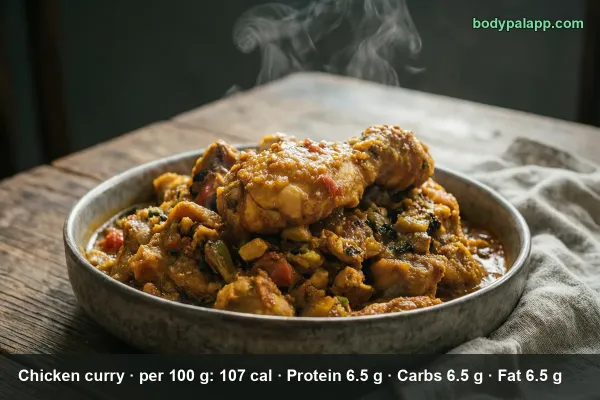
The ratio of curry to rice is the lever you control. More curry and less rice shifts the plate toward protein and fat; more rice pushes the carb share higher. Plain chicken curry on its own runs 6.5 g each of protein, carbs and fat per 100 g, which shows how much of the carb load the rice adds.
Sodium is the row to watch
One cup of curry rice holds 648 mg of sodium, 28% of the daily value. The same cup is only 12% of daily calories, so sodium runs at more than twice its calorie share. That gap is what makes this dish worth a second look on the label.
Portions multiply it quickly. Two cups bring 1,296 mg of sodium, three cups 1,944 mg, and the five-cup pot 3,240 mg. A second helping at dinner can push one meal into territory that most people spread across a whole day.
If you watch sodium, keep the rice plain and let the curry be the only salted part of the plate. Pairing it with unsalted steamed vegetables or a simple salad stretches the bowl without adding salt. The rest of the label is calm: potassium is 182 mg and cholesterol a low 13 mg per 100 g.
Beef, chicken and lentil versions land within a few calories
Swapping the protein barely moves the calories. A 200 g serving comes to 232 calories with chicken, 238 with beef and 236 with lentils. If calories are your only concern, pick whichever version you enjoy most.
The real differences sit in the other rows. Beef gives the most protein at 11.2 g per serving, 22% of the daily value, with 8.1 g of fat. Chicken follows at 9.9 g of protein. Lentil curry rice drops to 6.6 g of protein but more than doubles the fiber to 4.4 g and pushes carbs to 37.2 g, so it is the version that fills you up with plants rather than meat.
Sodium stays in a narrow band: 628 mg for beef, 648 mg for chicken and 656 mg for lentil. Packaged options such as Goya Curry Rice With Carrots & Onions or Knorr Thai Curry Rice & Pasta Blend follow their own recipes, so read the label on the box before you log them.
How does curry rice compare?
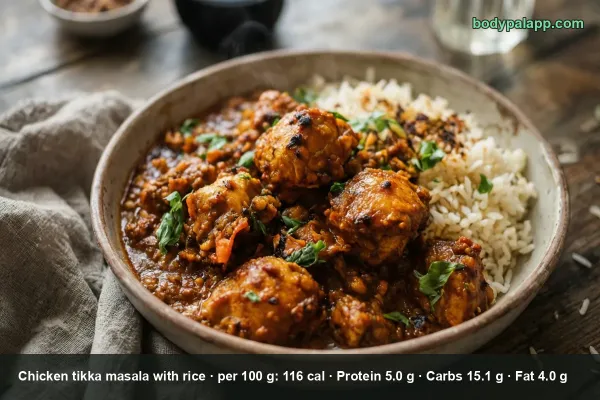
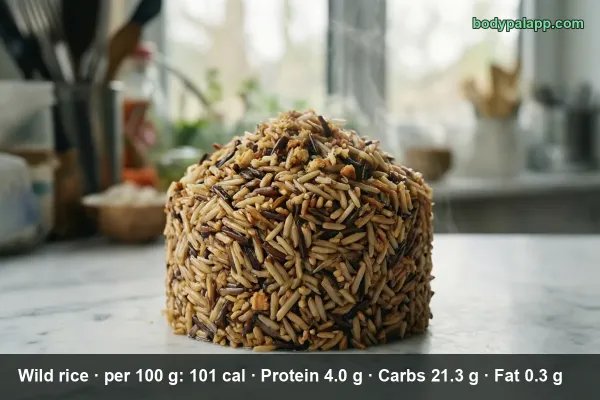
Here is curry rice next to chicken tikka masala with rice, chicken curry and wild rice, compared per 100 g and per usual serving.
Verdict: For the fewest calories and almost no salt, wild rice wins at 101 calories and 3 mg of sodium per 100 g, but it is a side, not a meal. For a complete plate with more protein, chicken curry at 107 calories and 6.5 g of protein per 100 g beats curry rice, especially if you measure your own rice next to it.
Most popular curry rice brands in the United States
Ranked by popularity in the BodyPal database
# Productkcal / 100 g
1Goya Curry Rice With Carrots & Onions1/4 cup · 45 g333 kcal
2Whole Foods Market Green Curry Rice & Veggies1/2 bag · 227 g132 kcal
3A Taste of Thai Yellow Curry Rice3/4 cup dry · 50 g360 kcal
4Lotus Foods Organic Sprouted Thai Red Curry Rice2 oz · 57 g351 kcal
5Hannaford Curry Chicken Over Basmati Rice Bowl12 oz · 340 g168 kcal
6Knorr Thai Curry Rice & Pasta Blend1/2 cup · 68 g368 kcal
Some of these are dry seasoned rice mixes labeled by uncooked weight, so they read well above the cooked curry rice number above; the ready-to-eat bowls are closer. Source: manufacturer labels / USDA FoodData Central.
Curry rice FAQs
How many calories are in curry rice?
A cup (200 g) of chicken curry rice has about 232 calories. Beef curry rice is close at 238 calories per cup, and per 100 g the chicken version is 116 calories.
Is curry rice good for weight loss?
At 116 calories per 100 g, curry rice is a moderate-calorie dish; a cup (200 g) of the chicken version is 232 calories with 9.9 g protein and 8.0 g fat.
Curry rice vs chicken curry: which has more calories?
Chicken curry with rice is 116 calories per 100 g, while chicken curry alone is 107, so the rice adds about 9 calories per 100 g.
How much protein is in curry rice?
A cup of chicken curry rice has 9.9 g of protein, from 4.96 g per 100 g. The beef version has more, at 11.2 g protein per cup.
How much sodium is in a cup of curry rice?
A cup (200 g) of curry rice has 648 mg of sodium, 28% of the daily value. Per 100 g it is 324 mg. Two cups reach 1,296 mg, so portion size matters more for sodium than for calories.
How many calories are in beef curry rice?
Beef curry with rice has 238 calories per 200 g serving, slightly more than the 232 in the chicken version. It also brings 11.2 g of protein and 8.1 g of fat, with 628 mg of sodium.
Is lentil curry rice lower in calories than chicken curry rice?
Not really. Lentil curry rice has 236 calories per 200 g, close to the 232 in chicken curry rice. It has less protein at 6.6 g but more fiber, 4.4 g versus 2 g.
How many calories are in two cups of curry rice?
Two cups (400 g) of curry rice come to 464 calories, with 19.8 g of protein and 1,296 mg of sodium. Three cups reach 696 calories.
How much fat is in curry rice?
One cup of curry rice has 8 g of fat, and fat supplies 31% of its calories. Per 100 g it is 4 g of fat, of which 1 g is saturated.