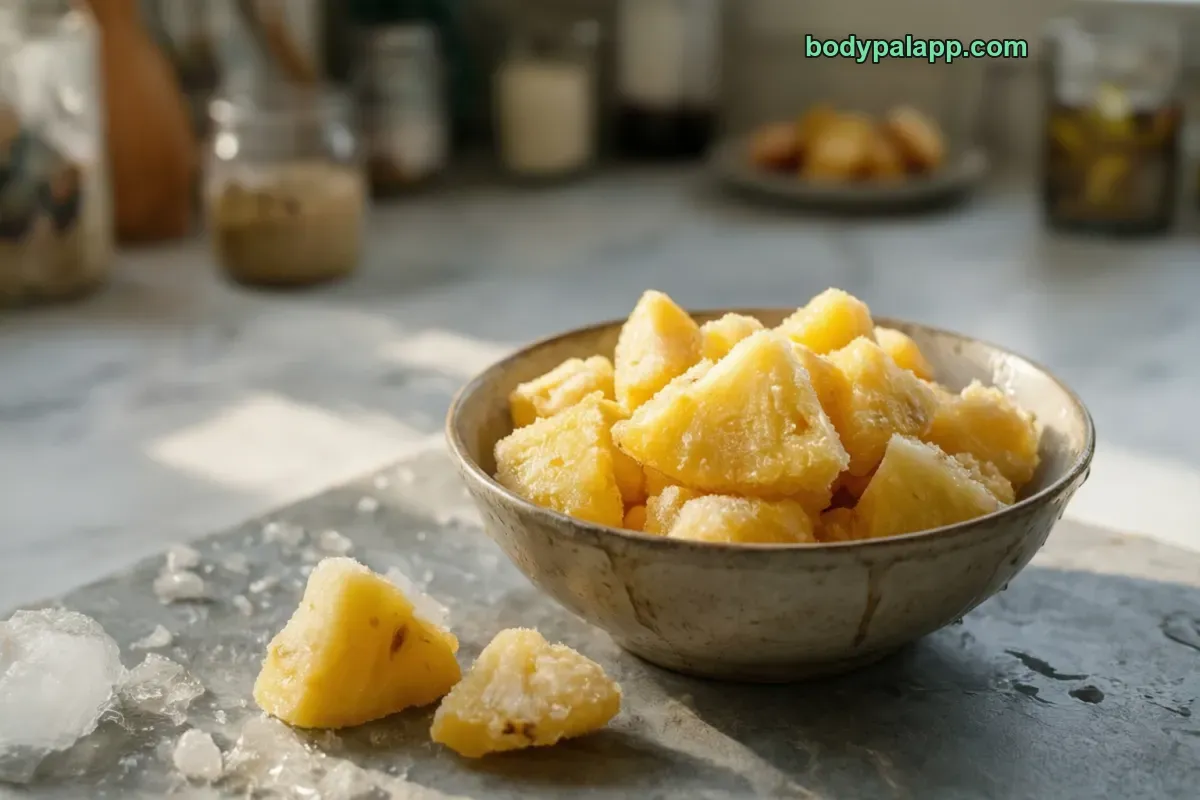
Frozen pineapple calories come to 90 for a 1 cup (150 g) serving and 60 per 100 g of unsweetened fruit. Almost all of that energy is carbohydrate, about 94% of the calories, with 17.1 g of sugar per cup and next to no fat, sodium or protein.
90kcal
1 cup · 150 g, frozen, unsweetened
3%protein
0.7 gProtein
21 gCarbs
0.3 gFat
How to burn off 90 kcal
—Walking, brisk
—Jogging
—Cycling, moderate
—Swimming
Skip the math. BodyPal counts these calories from your steps and workouts automatically.
Nutrition facts
Frozen, unsweetened · per 150 g
Calories
90 kcal
Protein
0.7 g
Carbohydrate
21 g
Fat
0.3 g
Saturated fat
0 g
Cholesterol
0 mg
Sodium
0 mg
Potassium
206 mg
Iron
0.1 mg
Source: USDA FoodData Central
🛡️
Verified nutrition data
Numbers on this page come from USDA FoodData Central, the U.S. Department of Agriculture’s food composition database, and from manufacturer labels where a branded product is named. Last verified October 2026. How we verify our data →
Frozen pineapple: calories, protein and sodium by serving
Percent of daily value uses the FDA reference of 2,000 kcal a day.
Serving
kcal
Protein
Carbs
Fat
Sodium
% DV kcal
1 cup (150 g)
90
0.7 g
21.1 g
0.3 g
0 mg
5%
1 chunk (15 g)
9
0.1 g
2.1 g
0 g
0 mg
0%
Sweetened, 1 cup (245 g)
211
1 g
54.4 g
0.2 g
5 mg
11%
100 g
60
0.5 g
14.1 g
0.2 g
0 mg
3%
3 × 1 cup (150 g)
270
2.1 g
0 mg
5 × 1 cup (150 g)
450
3.5 g
0 mg
One cup is 90 calories, one chunk is 9
The standard serving is 1 cup, which weighs 150 g and lands at 90 calories. That is 5% of the daily calorie value used on this page. A single chunk weighs about 15 g and carries 9 calories, so a handful eaten straight from the bag adds up slowly.
Portions grow the total in a straight line. Two cups (300 g) come to 180 calories, three cups (450 g) to 270, and a big smoothie batch of five cups (750 g) to 450. Even that full 750 g gives only 3.5 g of protein, so a bigger bowl buys you more sugar and carbs, not much else.
The weight matters more than the cup. Frozen chunks are irregular, so a heaped cup and a level cup can differ noticeably. Weighing out 100 g gives a clean 60 calories and removes the guesswork, which is the simplest habit if you track closely.
Carbs supply 94% of every calorie
The calorie split is lopsided: 94% carbohydrate, 3% protein and 3% fat. Per 100 g that works out to 14.1 g of carbs, 0.5 g of protein and 0.2 g of fat, with 0 g of saturated fat and 0 mg of cholesterol. This is a fruit that runs almost entirely on carbohydrate.
Most of that carbohydrate is sugar. A cup holds 21.1 g of carbs, of which 17.1 g is sugar, all of it from the unsweetened fruit itself. Fiber is modest at 1.4 g per cup against a daily value of 28 g, so pineapple is not the fruit to lean on for fiber.
Sodium reads 0 mg, and potassium comes to 137 mg per 100 g. If you track sugar rather than calories, the sugar row is the one to watch here. Fat and salt simply are not part of the picture.
Sweetened frozen pineapple more than doubles the count
The 90 calories on this page assume the unsweetened kind: plain fruit with nothing added. USDA also lists a sweetened version, and a 1 cup serving of it weighs 245 g and comes to 211 calories, or 11% of the daily calorie value.
The sugar gap is the bigger story. That sweetened cup carries 51.7 g of sugar and 54.4 g of carbs, against 17.1 g of sugar and 21.1 g of carbs in an unsweetened cup. Part of the difference is weight, since the sweetened cup is heavier. The rest comes from the added sweetener.
Read the ingredient list before you buy. If it names only pineapple, the 60 per 100 g figure applies. If sugar or syrup appears, use the sweetened numbers instead. Product names like Del Monte Fresh Frozen Pineapple Spears or Raley's Fresh Frozen Pineapple Chunks do not tell you which kind you have, so check each bag rather than assuming.
Pair it with protein to make it a meal
On its own, frozen pineapple is a light, sweet item: 90 calories and 0.7 g of protein per cup, just 1% of the daily protein value. It works well as a dessert swap or a smoothie base. Because it is nearly all sugar and carbs, it reads more like a snack than a meal.
Blend a cup with yogurt, milk or protein powder, or spoon it over cottage cheese, and the bowl gets the protein and fat the fruit lacks. Those additions carry their own calories, so log them separately instead of counting only the fruit. A smoothie can quietly outgrow the 90 calories of the pineapple many times over.
Half-thawed chunks also make an easy cold snack without anything added. BodyPal can log the bowl from a photo, so the pineapple and whatever you pair it with land in your diary together.
How does frozen pineapple compare?
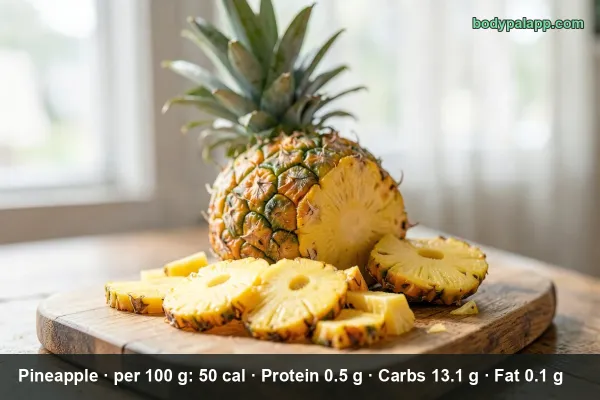
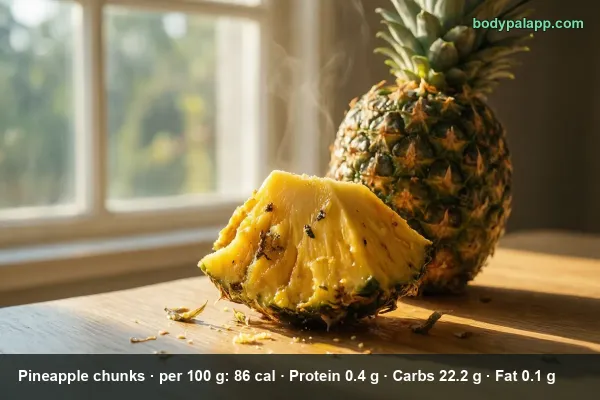
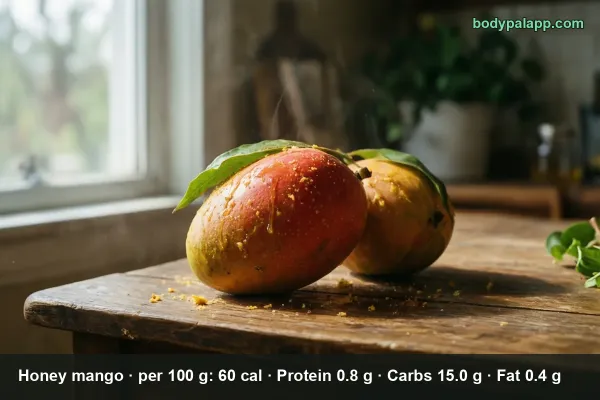
Here is how frozen pineapple stacks up against fresh pineapple, pineapple chunks and honey mango, per 100 g and per usual serving.
Verdict: For the lowest count pick fresh pineapple at 50 calories per 100 g, while frozen pineapple and honey mango tie at 60. Skip the pineapple chunk entry at 86 per 100 g if you count closely, since it runs about 1.4 times the calories of frozen.
Most popular frozen pineapple brands in the United States
How many calories are in a cup of frozen pineapple?
About 90 calories in 1 cup (150 g) of unsweetened frozen pineapple, and about 9 in a single chunk (15 g).
Is frozen pineapple good for weight loss?
Unsweetened frozen pineapple has 60 calories, 0.2 g fat and 0.9 g fiber per 100 g. The sweetened kind has 86 calories per 100 g.
Frozen pineapple vs fresh pineapple: which has fewer calories?
Per 100 g, frozen pineapple has 60 calories and fresh raw pineapple 50.
How much sugar is in frozen pineapple?
A cup (150 g) has 17.1 g sugar and 21.1 g carbs. Sweetened frozen chunks have 21.1 g sugar per 100 g.
How many calories are in one frozen pineapple chunk?
One chunk of about 15 g has 9 calories, with 2.1 g of carbs and 1.7 g of sugar. That makes chunks easy to count one at a time if you snack straight from the bag.
Is sweetened frozen pineapple higher in calories?
Yes. A 1 cup (245 g) serving of sweetened frozen pineapple has 211 calories and 51.7 g of sugar, compared with 90 calories and 17.1 g of sugar in an unsweetened 1 cup (150 g) serving.
How much protein is in frozen pineapple?
Very little: 0.7 g per cup (150 g) and 0.5 g per 100 g. Protein makes up just 3% of its calories, so pair it with yogurt or another protein source for a more filling snack.
How many carbs are in a cup of frozen pineapple?
A 1 cup (150 g) serving has 21.1 g of carbohydrates, including 1.4 g of fiber. Per 100 g the figure is 14.1 g, and carbs supply 94% of the calories.
Does frozen pineapple have more calories than mango?
No, they tie. Frozen pineapple and honey mango both have 60 calories per 100 g. Mango carries slightly more protein, 0.8 g versus 0.5 g, and more fat, 0.4 g versus 0.2 g.