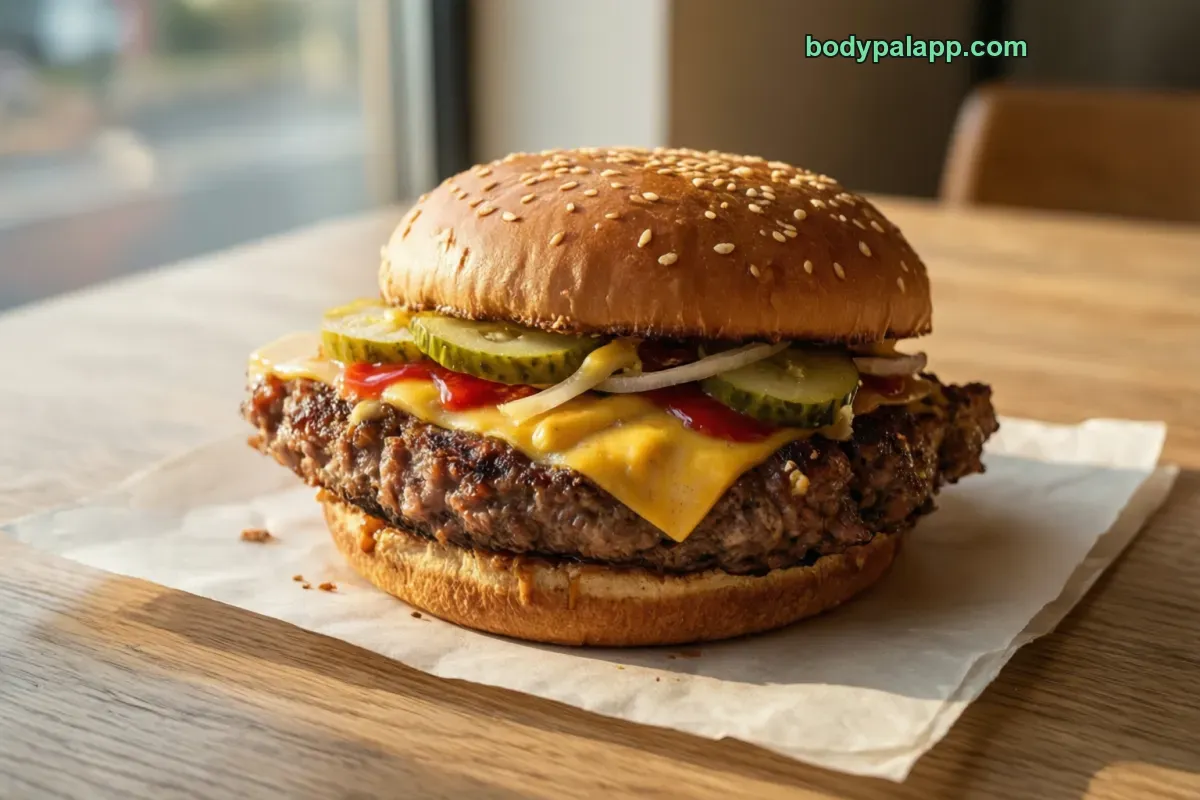
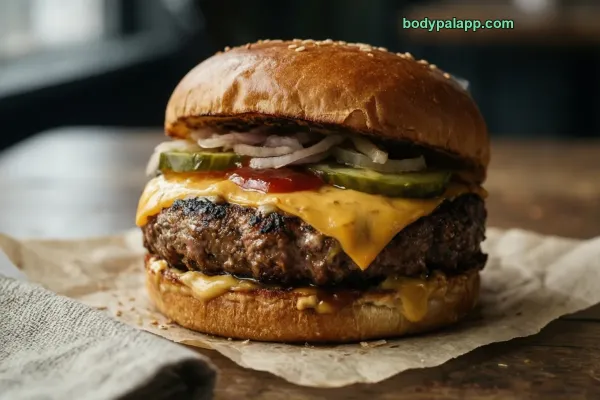
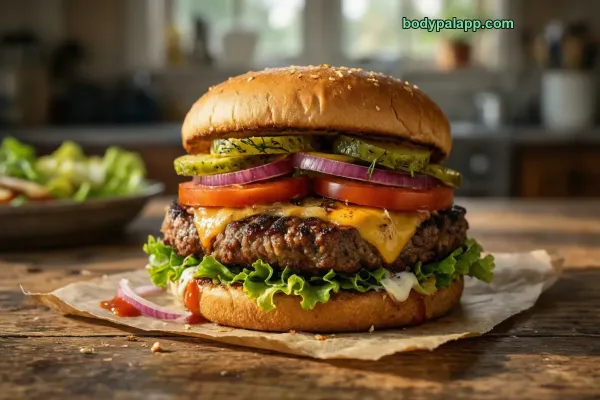
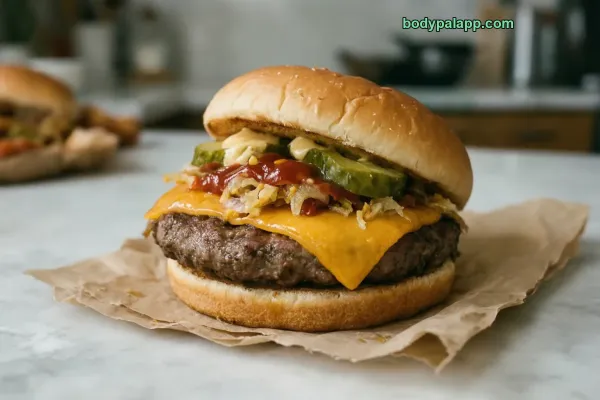
Quarter pound cheeseburger calories come to 535 for one 199 g burger and 269 per 100 g. Fat supplies 48% of those calories, but sodium is the number that stands out: 1,176 mg in a single sandwich, or 51% of the daily value. Protein is the upside, at 30.3 g per burger.
535kcal
1 burger · 199 g, fast food, with condiments
23%protein
30 gProtein
39 gCarbs
29 gFat
How to burn off 535 kcal
—Walking, brisk
—Jogging
—Cycling, moderate
—Swimming
Skip the math. BodyPal counts these calories from your steps and workouts automatically.
Nutrition facts
Fast food, with condiments · per 199 g
Calories
535 kcal
Protein
30 g
Carbohydrate
39 g
Fat
29 g
Saturated fat
14 g
Cholesterol
96 mg
Sodium
1176 mg
Potassium
444 mg
Iron
2 mg
Source: USDA FoodData Central
🛡️
Verified nutrition data
Numbers on this page come from USDA FoodData Central, the U.S. Department of Agriculture’s food composition database, and from manufacturer labels where a branded product is named. Last verified October 2026. How we verify our data →
Quarter pound cheeseburger: calories, protein and sodium by serving
Percent of daily value uses the FDA reference of 2,000 kcal a day.
Serving
kcal
Protein
Carbs
Fat
Sodium
% DV kcal
1 burger (199 g)
535
30.3 g
39.2 g
28.7 g
1,176 mg
27%
Regular cheeseburger (165 g)
488
29.5 g
30.9 g
26.6 g
723 mg
24%
100 g
269
15.2 g
19.7 g
14.4 g
591 mg
13%
3 × 1 burger (199 g)
1,606
90.8 g
3,528 mg
5 × 1 burger (199 g)
2,677
151.3 g
5,880 mg
One burger is 27% of a day's calories
A single large-patty cheeseburger with condiments weighs 199 g and lands at 535 calories, with 30.3 g protein, 39.2 g carbs and 28.7 g fat. That is 27% of the daily value for calories in one sandwich, before fries or a drink join the tray. These are USDA fast-food values for a generic burger of this size, not figures from any one chain's menu board.
A regular cheeseburger of 165 g comes in at 488 calories. The gap is smaller than you might expect, because the regular version still carries 26.6 g fat and 29.5 g protein. Most of what disappears is bun: carbs drop from 39.2 g to 30.9 g, and sugars from 7.2 g to 4.9 g.
Doubling up is where the totals run away. Two burgers (398 g) reach 1,071 calories, three (597 g) reach 1,606, and five hit 2,677. If you order a second sandwich, treat it as a second meal, not a side.
Fat supplies nearly half the calories
The calorie split is 48% fat, 29% carbs and 23% protein. Per 100 g that works out to 14.4 g fat, 19.7 g carbs and 15.2 g protein for 269 calories. Carbs outweigh fat by grams, yet fat still delivers the biggest share of energy, because each gram of fat carries more than twice the calories of a gram of carbs.
Saturated fat runs 7 g per 100 g, set against a daily value of 20 g, and the full burger holds close to double that amount. Cholesterol is 48 mg per 100 g against a 300 mg daily value. Neither is extreme for a single meal, but both climb fast if you add bacon, extra cheese or a second patty.
Protein is the strong row. One burger gives 30.3 g, which covers 61% of the 50 g daily value, and two burgers reach 60.5 g. Fiber is the weak one: 2.4 g per burger against a 28 g daily value. Sugars stay modest at 7.2 g, mostly from the bun and the condiments.
Sodium is the row to watch
One burger carries 1,176 mg of sodium, which is 51% of the daily value. Per 100 g the figure is 591 mg. That means a single sandwich uses up about half the day's sodium allowance, while delivering only 27% of the day's calories. The salt load is out of proportion to the energy.
Stack burgers and the number crosses the line quickly. Two burgers come to 2,352 mg, already past the full daily value on their own. Three reach 3,528 mg, and five hit 5,880 mg. Anything salty on the side, such as fries, pickles or a dipping sauce, adds on top of those totals.
If you watch sodium, the regular cheeseburger is the easier pick. At 165 g it carries 723 mg, or 31% of the daily value, while giving up only a little protein: 29.5 g against 30.3 g. Potassium is low in both, at 223 mg per 100 g for the larger burger, so the rest of the day's food has to do that work.
Build the rest of the day around it
At 535 calories and 30.3 g protein, this burger works as a full main meal by itself. The smart sides are the ones that fill gaps the burger leaves: fiber, potassium and volume. A side salad, a piece of fruit or raw vegetables add bulk with few calories, and water or an unsweetened drink keeps the meal from growing further.
Plan the other meals of the day lighter in salt. With 51% of the sodium daily value already spent, home-cooked meals built on vegetables, beans, eggs or plain meats leave room without pushing the total much higher. Skipping the second burger matters far more than trimming a condiment.
If you eat one of these regularly, logging it keeps the weekly picture honest. BodyPal can log the burger from a photo, so the 535 calories and 1,176 mg of sodium show up in your day without manual entry.
How does quarter pound cheeseburger compare?
Here is how the quarter pound cheeseburger stacks up against the Quarter Pounder with Cheese, Dave's Single and the McDonald's cheeseburger, per 100 g and per usual serving.
Verdict: For the fewest calories, the McDonald's cheeseburger wins at 313 per sandwich, though its 626 mg of sodium per 100 g is the highest of the group. For protein, this burger leads at 15.2 g per 100 g, while Dave's Single has the lowest sodium at 473 mg per 100 g but the biggest serving at 576 calories.
Most popular quarter pound cheeseburger brands in the United States
These are packaged ready-to-heat retail cheeseburgers, usually smaller than a quarter-pound patty and made with different buns, cheese and beef, so their label values differ from a restaurant quarter-pound cheeseburger. Source: manufacturer labels / USDA FoodData Central.
Quarter pound cheeseburger FAQs
How many calories are in a quarter pound cheeseburger?
About 535 calories for one 199 g fast food cheeseburger with a large patty and condiments.
Is a quarter pound cheeseburger good for weight loss?
One burger has 535 calories, 29 g fat (14 g saturated) and 30 g protein. That is 269 calories per 100 g.
Quarter pound cheeseburger vs Quarter Pounder with Cheese: which has more calories?
Per 100 g, a quarter pound cheeseburger has 269 calories and a Quarter Pounder with Cheese has 258.
How much protein is in a quarter pound cheeseburger?
About 30.3 g of protein per 199 g burger, along with 39.2 g of carbs and 1176 mg of sodium.
How much sodium is in a quarter pound cheeseburger?
One 199 g burger has 1,176 mg of sodium, which is 51% of the daily value. Per 100 g it carries 591 mg. A regular 165 g cheeseburger is lower at 723 mg.
How many calories are in two quarter pound cheeseburgers?
Two burgers (398 g) come to 1,071 calories. They also bring 60.5 g of protein and 2,352 mg of sodium, which is more than a full day's sodium daily value.
How much fat is in a quarter pound cheeseburger?
One burger has 28.7 g of fat, and fat supplies 48% of its calories. Per 100 g there is 14.4 g of fat, including 7 g of saturated fat.
Quarter pound cheeseburger vs McDonald's cheeseburger: which has more calories?
The quarter pound cheeseburger has 535 calories per 199 g burger, against 313 for a 119 g McDonald's cheeseburger. Per 100 g they are close: 269 versus 263 calories.
How many carbs are in a quarter pound cheeseburger?
One burger has 39.2 g of carbs, with 7.2 g of sugars and 2.4 g of fiber. Carbs supply 29% of the calories, at 19.7 g per 100 g.